
You can't fix what you can't measure. In longevity, the outcome we have validated is death.
Vibrome® biosignatures are a passive, over-clothing measurement of the body's biomechanical state — cardiac, respiratory, vascular, gastrointestinal and musculoskeletal — captured longitudinally, in about ten minutes.
Anthropophony™ is a research platform. Nothing on this page is a medical device claim or a diagnosis.
 Powered by Vibrome® signals
Ask geroscience its biggest roadblock. The answer is unanimous: measurement.
There is no validated biomarker of aging. Without an accepted surrogate endpoint, a therapy that genuinely bends the longevity curve has to wait for hard outcomes — disease, disability, death — which takes thirty to fifty years to accumulate. The field can design interventions faster than it can tell whether they worked.
Three ways today's measurement falls short
Snapshots, months apart
A reading here, a scan there. Between visits the variables that define trajectory go unobserved — recovery speed, cardiopulmonary coupling, reserve after exertion.
Downstream, not upstream
Chemistry and imaging record consequences. By the time a marker moves, the mechanical change that produced it has already happened.
Population, not person
A value inside a reference range can still be a large departure from your own history. Without that history, a single reading has nothing to be compared against.
Fast, slow and compressed-morbidity trajectories diverge long before today's snapshots can separate them.
Biology breaks mechanically before it breaks chemically or electrically.
The heart is a fluid engine. The lungs are gas bellows. The gut is a rhythmic pump. Every one of them moves, and moving tissue radiates mechanical energy through a layered, pre-stressed body and out to the skin.
A stiffening vessel, a congested lung, a decoupled gut changes how the body transmits that energy before an enzyme shifts or a scan changes. Disease is not only structural damage — it is a change in how a system transmits and dissipates energy.
The system falls out of tune before it breaks.
The physics behind Vibrome®
This is the part that is not a metaphor. For decades, seismocardiography, ballistocardiography and forcecardiography have shown that cardiac mechanics and blood flow generate measurable body motion, and are established modalities with a literature behind them. Vibrome® extends this established principle beyond the heart, across broader anatomical sources, specific disease states, wider frequency ranges, and longer windows of physiological change.
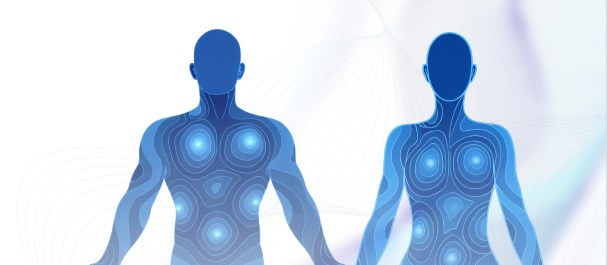
One body. Three clocks. One lifetime.
Aging is not a separate disease running alongside the others. It is what is left after them. Health gets interrupted on three timescales, and the same class of mechanical signal is disturbed on all three.
Acute infectious disease
Pneumonia, tuberculosis, COVID-19, sepsis. Turbulence rises, high-frequency energy increases, cardiopulmonary coupling breaks and then, if the person recovers, re-forms. Fast disease gives the cleanest possible view of one thing: the shape of a return.
Chronic non-communicable disease
Heart failure, COPD, hypertension, the vascular disease of diabetes, disordered gut motility. Damping and stiffness change gradually, resonances migrate, harmonic structure thins. Slow disease shows the drift.
Developmental and degenerative trajectories
Fetal and neonatal lung maturation, arterial stiffening, sarcopenia and frailty, bone mineral loss, progressive kidney and pulmonary fibrosis. These are not events. They are slopes. They are also precisely where a longevity intervention would have to show its effect.
Healthspan is the interval between interruptions. Lifespan is what they add up to.
Each episode ends a stretch of stable physiology and, if the system is resilient, begins another. Death is the interval that fails to restart. That has a practical consequence: a longevity measurement does not need its own thirty-year study. It can be tested against fast disease this year and slow disease this decade, because across all three timescales the quantity being measured is the same one.
Health is the persistence of organized motion under entropy load.
We describe physiology the way engineering describes any dynamic system — by its transfer function, in the grammar Oliver Heaviside gave it in the 1890s. Structure sets how waves travel, physiology sets what drives them, and aging deforms the result.
Aging deforms the pole structure. Poles drift and couple, entropy rises, and the spacing that keeps organ signals separable collapses.
Six terms, defined as properties of one system
- Health
- A stable, well-separated pole configuration.
- Disease
- A perturbation of that configuration.
- Aging
- The entropy-driven deformation of the pole and residue structure.
- Healthspan
- The duration for which the stability margin stays above threshold.
- Lifespan
- The first-passage time to instability.
- Resilience
- The capacity to restore the configuration after a perturbation.
The master equation describes how that system changes over time. Select any term to see what it governs.
Flow drives the system.
Airflow, blood flow and gut motility drive mechanical energy into the system. When flow changes — a narrower vessel, a stiffer airway, a different cardiac output — the mechanical signal changes with it, often before a person notices anything.
Simulated illustration of how this term changes signal shape. Not measured data.
This is a conceptual model for organizing measurable biomechanical features over time. It states which forces we believe are worth measuring separately. It is not a solved equation of human health, and no term in it is a validated clinical endpoint.
Ten minutes. Over clothing. Nothing enters the body.
A passive recording of broad-frequency body-borne waves. It emits nothing — no radiation, no contrast, no injection, no sample. The sensor listens; the body does the work. Across more than 20,000 subjects of human data collected to date, no device-related adverse events have been reported.

One signal, three bands, three kinds of information
Global physiological state: pulsatile flow, compliance, respiratory loading, autonomic modulation, tensegrity-scale coupling. Most of the population-level, physics-stable information sits here.
Transitions between states — where one subsystem hands energy to the next.
Local texture, transients, turbulence, fracture-like tissue events. Powerful for detail, unreliable as a foundation — more site-specific and more attenuated.
The body already measures itself mechanically. We read the same variables from outside.
Baroreceptors read arterial wall stretch beat to beat. Mechanoreceptors in lung, heart, gut, vessels, fascia and bone read stretch, pressure and flow in milliseconds. Note what those sensors actually sense: not chemistry, but force, flow, stretch and timing.
Clinical measurement works the other way round. Glucose, oxygen saturation, pH, cortisol are all valuable, all chemical or electrical, and all measured after homeostasis has already shifted. Vibrome® reads the same mechanical streams the body's own sensors use — from the skin surface.
Not another biomarker test. An externalized homeostasis sensor.
From distributed signals to one readable view.
42ndMovement™ summarizes Vibrome® features into something a person can watch over time — while keeping every component, its context and its signal quality one click away.
42ndMovement™
longitudinal index · illustrative view
Each component against this person's own baseline
Signal quality: high · 26 of 30 nights captured · baseline established over 41 days
Illustrative interface. Not a clinical result.
Accumulated Variance Age™
The integral of your departure from your own baseline — distance travelled from your own history, not your position on a population curve.
MechanoResilience Score™
A continuous read on recovery capacity: how far the signal moves, how quickly it returns, and how consistently the rhythms re-couple once it gets there.
A score without its decomposition, its context and its confidence is a mood ring — so 42ndMovement™ ships with all three. We do not call it a biological age, a longevity score or a disease risk score, and none of it is validated as a clinical endpoint.
What exists today is disease data. Longevity data is the work ahead.
Vibrome® recordings have been collected across fast conditions (acute infectious), slow conditions (non-communicable cardiopulmonary and gut) and slowest-timescale ones (developmental and degenerative), at leading clinical research centers.
No device-related adverse events have been reported to date. What this data does not establish: longevity is not a validated surrogate endpoint — not for us, not for anyone; no Vibrome®-derived index is cleared or approved as a diagnostic; and evidence for disease-state discrimination is not evidence for longevity measurement.
Designed for lifespan longitudinal discovery.
Anthropophony™ is the human platform in a family of Vibrome® applications. Four kinds of work fit it today.
Healthspan research
Follow how individual biosignature patterns evolve across months and years, with context attached to every sample.
Aging and resilience
Treat response, recovery and coordination as measurable dynamics rather than descriptive language.
Performance and recovery
Observe how mechanical patterns shift around training, exertion, rest and return to load.
Digital biomarker development
Turn repeatable signal features into testable longitudinal endpoints. If a biomechanical measure qualifies as an intervention-sensitive endpoint, a trial that reads out in decades could read out in weeks.
Anthropophony™ is one instrument on the staff.
The same Vibrome® signal class runs across people, animals and machines. Each brand is a different instrument reading the music of the universe.




 Healthspans & longevity

Straight answers.
What is the Vibrome®?
The Vibrome® is Level 42 AI's framework for capturing and analyzing the mechanical and related biosignatures that a living system generates over time — and for turning them into features that can be compared against that individual's own history.
Is the Vibrome® the same as sound?
No. Audible sound is a small slice of it. The Vibrome® covers measurable mechanical motion across a much wider frequency range and several sensing modalities — most of it imperceptible to a person and inaudible to a stethoscope.
Why does time matter so much?
Because physiology is scheduled. Sleep, circadian phase, feeding, activity, recovery and stress all modulate the signal. Without time and context the same reading can mean opposite things; with them, a single person becomes their own control group.
What does 42ndMovement™ represent?
A longitudinal summary layer over Vibrome® features. It is designed to be readable at a glance while preserving access to the components underneath, the context they were captured in, and how much usable signal supports the result.
Does Anthropophony™ provide a medical diagnosis?
No. Intended use depends on the specific product and application, and research or wellness outputs should not be interpreted as a diagnosis unless that is explicitly stated in a product's authorized labeling. US policy distinguishes general wellness functionality from software intended to diagnose, treat, mitigate or prevent disease, and we position accordingly.
Why is there no validated biomarker of aging?
Because validating one requires showing that a measurement predicts an outcome, and the outcome for longevity is death or major disease — which takes thirty to fifty years to accumulate. That circularity is the central roadblock in geroscience: you cannot shorten a trial without a surrogate endpoint, and you cannot validate a surrogate endpoint without a long trial. Measuring something that changes on shorter timescales, in the same person, against the same underlying quantity, is one way out.
How can you say anything about longevity from studies of infections and chronic disease?
Because we treat them as three timescales of the same measurement rather than three different subjects. Acute infection is a fast, large perturbation with a recovery you can watch in days. Chronic disease is a slow drift over months and years. Developmental and degenerative trajectories are decades-long slopes. Across all three, the quantity being measured is the stability of the same mechanical configuration — which means a longevity measurement can be tested against fast disease now rather than waiting decades. What that does not do is validate a longevity endpoint. Only a longevity study does that.
Is Vibrome® a diagnostic device?
No. The imPulse® UNA transducer platform is registered and listed with the FDA under product code DQC, listing ID 922165, but listing is not clearance or approval, and no Vibrome®-derived index is currently cleared or approved as a diagnostic. Current positioning is early detection, triage and wellness monitoring. Disease decision-support requires its own regulatory pathway.
What are the known limitations today?
Mechanical biosignatures are sensitive to sensor placement, posture, body composition and motion artifact. Baselines need weeks of data before a change is interpretable. And no Vibrome®-derived index is currently cleared or approved as a diagnostic. Those constraints shape every study we design, and we would rather state them than discover them with a partner mid-protocol.

Bring Vibrome® to your healthspan research.
Tell us what you are trying to measure and which change you keep missing.
- Research collaboration — cohorts, protocols, co-authorship
- Clinical research — reference comparison and validation studies
- Strategic and OEM partnership — sensing, integration, licensing
- Investment — technology, roadmap, evidence plan
Request received.
Our team will review it and follow up with the research or partnership material that matches what you described.